

If your stockinette is rolling up at the edges, nothing has gone wrong and you have not done anything badly. Stockinette curls by nature, because its two faces pull against each other. The fix is not knitting tighter, it is giving the fabric an edge that cannot curl, then blocking what is left.
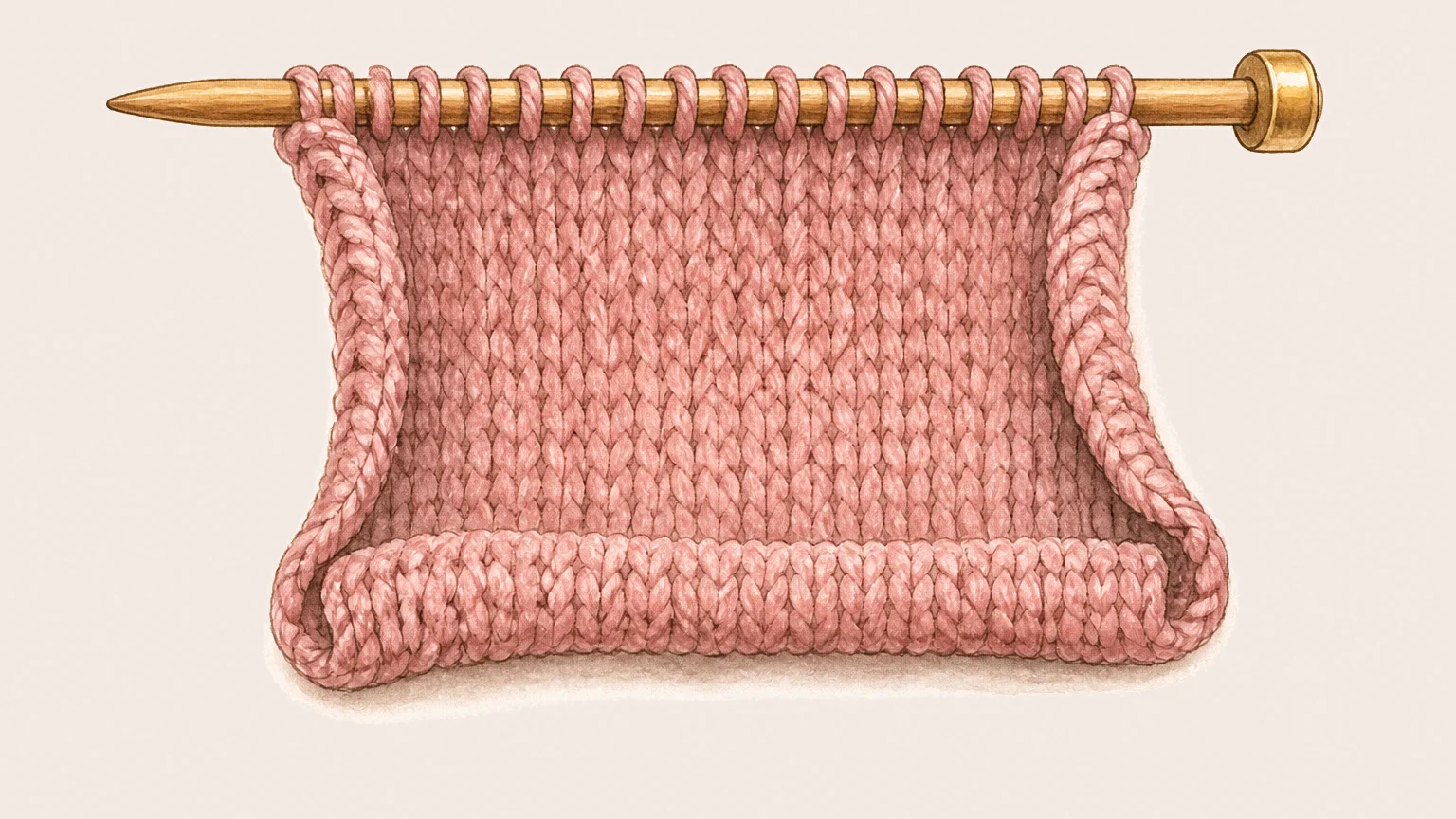
Why does stockinette curl?
A knit stitch is wider than it is tall, and it sits differently from a purl stitch. In stockinette you put all the knits on one face and all the purls on the other, so the two sides pull by different amounts. At a free edge there is nothing to balance them, and the fabric rolls.
It rolls in a predictable way, which is a good way to confirm this is what you are seeing:
- The cast on and bind off edges roll toward the purl side, so toward the back.
- The side edges roll toward the knit side, so toward the front.
Garter stitch and ribbing lie flat because they alternate knits and purls, so the pull cancels out.
Is it my tension?
Almost never. Very tight knitting curls harder, and very loose knitting curls more loosely, but stockinette curls at any tension. If your fabric is otherwise even, your tension is not the problem and knitting more carefully will not help.
What actually stops the curl?
A border of stitches that do not curl. You need it on all four sides: a few stitches at each side edge, and a few rows at the start and end.
| Border | How it looks | Best for |
|---|---|---|
| Garter, knit every row | Ridged, casual, very flat | Blankets, scarves, dishcloths |
| Ribbing, k1 p1 or k2 p2 | Stretchy, pulls in a little | Cuffs, hems, necklines |
| Seed or moss stitch | Textured, lies very flat | Blankets, edges meant to be seen |
| Applied edging or I-cord | Neat and rounded, added last | Shawls, finished garment edges |
Four to six stitches on each side and four to six rows top and bottom is enough for most yarns. Chunky yarn needs fewer, lace weight needs more.
How do I fix knitting that is already curling?
- Block it. Soak the piece, squeeze the water out in a towel, pin it flat to shape and let it dry completely. On wool this alone tames most of the curl.
- Steam it if the fibre allows. Hold the iron above the fabric, never on it. On acrylic, steam flattens it permanently but also kills the bounce, so test on a swatch first.
- Pick up and knit a border afterwards. You do not have to start over: pick up stitches along each edge and work a few rows of garter or ribbing.
- Seam it. In a sweater the curl disappears once the edges are sewn into the garment, so a curling piece is often not a problem at all.
Blocking alone relaxes the curl but does not remove it forever, because washing brings some of it back. A border is the only permanent fix.
See how to count stitches in knitting and how to count rows in knitting for the counting habits that keep a border even.
Keep your border even with Knittle
A border only works if it stays exactly the same width on every row. Lose or gain a stitch in it and the edge starts to wander, which looks worse than the curl you were fixing. Use Knittle to count your rows and stitches as you go, with custom and cyclic counters for repeats like k2 p2, kept and synced across your iPhone, iPad and Apple Watch.


