

If your knitting gets wider row after row, you are almost certainly making accidental increases without noticing. It is rarely one big mistake, it is one extra stitch every few rows. The causes are few and easy to recognise, and counting at the end of each row catches them while they are still a quick fix.
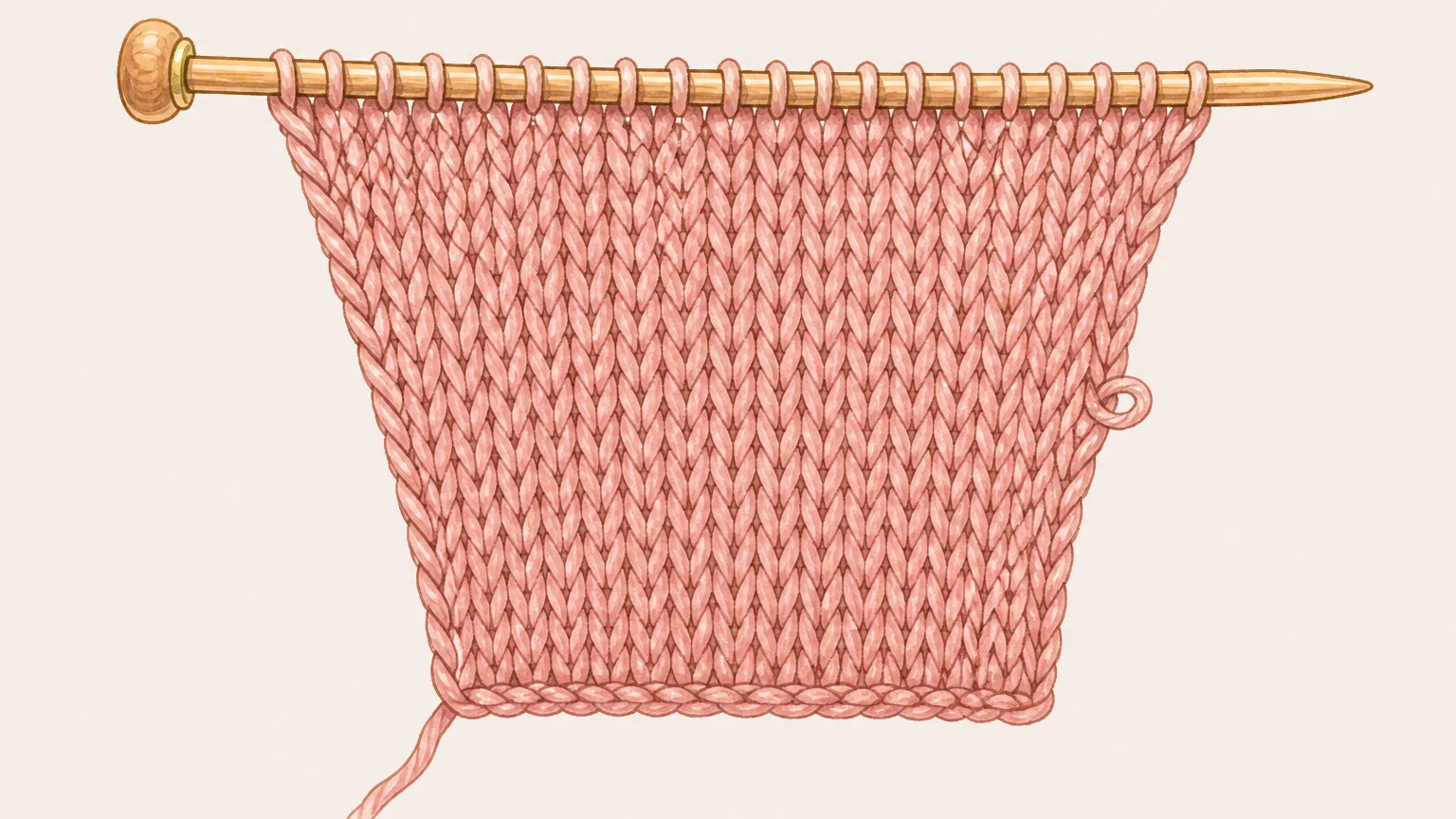
Where do the extra stitches come from?
Four things cause nearly every accidental increase:
- An accidental yarn over. You bring the yarn to the front to purl, then knit the next stitch without taking it back. The yarn crosses the needle and becomes a new loop. This is by far the most common cause.
- Working twice into the same stitch. Usually the first stitch of a row, especially when the fabric is loose or the stitch is stretched.
- Knitting the yarn tail or a split strand. The needle picks up half the plies and the stitch splits into two.
- The two loops at the start of a row. After turning, the first stitch can flop over the needle and look like two. Knit both and you have added one.
How do I tell which one it is?
Look at the extra stitch on the needle and at the row below it.
| What you see | What it is |
|---|---|
| A small hole under the extra stitch | An accidental yarn over |
| No hole, two stitches sitting close together | Worked twice into one stitch |
| A thin, fuzzy, weak looking stitch | A split stitch |
| The extra stitch is always at the very edge | The turning loop counted twice |
The hole is the giveaway. A yarn over leaves a visible eyelet, an extra stitch worked into an existing one does not.
How do I fix it?
- Count your stitches at the end of the row, before you turn.
- If the count is high, find the extra stitch by looking for the hole or the pair sitting together.
- If it is one or two rows down, drop the column of stitches back to it, undo the increase, and ladder it back up.
- If it is deeper than that, decide honestly whether it will show. On a scarf, a k2tog on the next row hides it. On a fitted garment, rip back.
- Fix a wrong row before you build on top of it. Ten rows later it is no longer a small job.
How do I stop it happening again?
- Check where your yarn is before every stitch. Behind for a knit, in front for a purl. Most accidental yarn overs are just the yarn left in the wrong place.
- Count at the end of every row, not every ten rows.
- On wide pieces, place a stitch marker every 20 or 50 stitches so a wrong count only sends you back to one section instead of the whole row.
- Give the first stitch of each row a small tug so the two loops separate and you can see which is which.
See how to count stitches in knitting and how to frog knitting and crochet without losing your place for the two skills this needs.
Catch it on the same row with Knittle
An extra stitch caught on the row you made it is a thirty second fix. Caught fifteen rows later it is a frogging session and an evening lost. Use Knittle's stitch and row counter to keep your count in front of you as you knit, with custom counters for repeats and a target so you know the moment a row does not add up. Everything stays on your device and syncs across your iPhone, iPad and Apple Watch.


