

If your finished piece came out too big, too small, or nothing like the measurements in the pattern, your gauge was off before you started. Gauge is simply how many stitches and rows you get over a set distance. When it does not match the pattern, every number in that pattern quietly means something different.
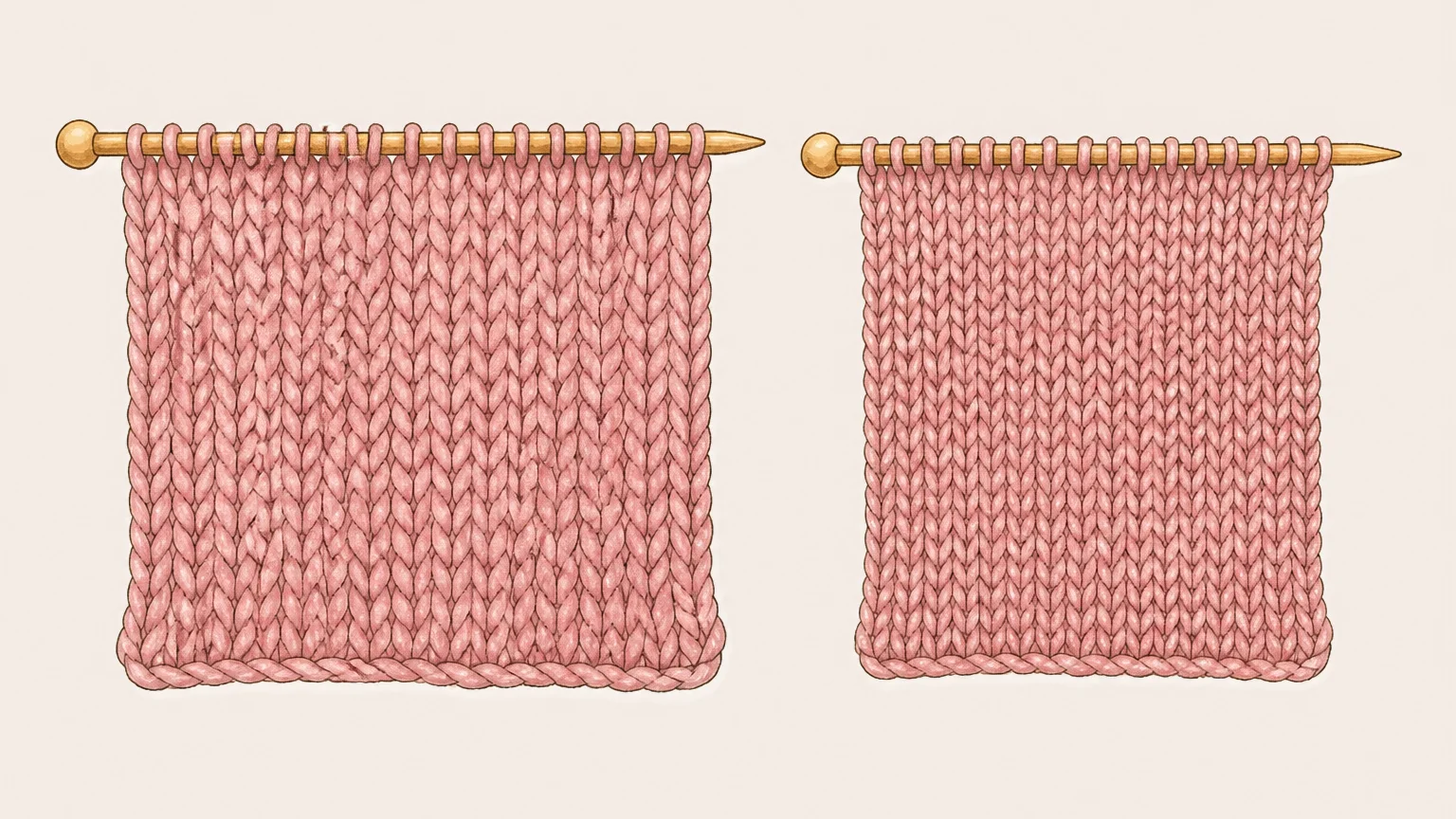
Why does a small gauge difference matter so much?
Because it multiplies. Half a stitch per inch sounds like nothing, but a sweater is not one inch wide.
| Pattern gauge | Your gauge | Sweater meant to be 100 cm |
|---|---|---|
| 20 sts / 10 cm | 20 sts / 10 cm | 100 cm |
| 20 sts / 10 cm | 19 sts / 10 cm | about 105 cm |
| 20 sts / 10 cm | 18 sts / 10 cm | about 111 cm |
| 20 sts / 10 cm | 22 sts / 10 cm | about 91 cm |
Two stitches out over 10 cm is a whole size. That is the entire reason patterns insist on a swatch.
Why is my gauge wrong?
- The swatch was too small. A 10 cm swatch cannot be measured over 10 cm, because the edges distort. Knit at least 15 cm square and measure only the middle.
- You measured at the edges. Edge stitches are always looser or tighter. Measure across the centre, away from every edge.
- You did not block the swatch. Most fibres change after a wash, and wool can change a lot. Measure the swatch in the state the finished piece will live in.
- You swatched flat but the piece is worked in the round. Many people purl at a different tension than they knit, so their flat gauge and round gauge differ. Swatch the way you will work.
- Different needles. Same size, different material, different tension. Metal, wood and plastic do not give the same gauge for everyone.
- You were tense, or very relaxed. Gauge on a stressful evening is not gauge on a calm one. This is real, and it is why a longer swatch is more honest than a short one.
How do I fix it?
- Knit a swatch of at least 15 cm square in the pattern stitch, not always plain stockinette.
- Wash and block it exactly as you will treat the finished piece, then let it dry fully.
- Lay it flat and measure across the middle, counting stitches over 10 cm. Do the same for rows.
- Too many stitches per 10 cm means your knitting is too tight, so go up a needle size. Too few means it is too loose, so go down a size.
- Swatch again with the new needle. Repeat until the stitch gauge matches.
- Write the result down: yarn, needle size, gauge, blocked or not. Next time with that yarn you start from a known number instead of guessing.
Match stitch gauge first. Row gauge is harder to control and most patterns let you work to a length rather than a row count, so it matters less.
Is a swatch really worth the time?
For a scarf or a blanket, often not. For anything fitted, a swatch costs you an evening and a wrong gauge costs you the whole project. See how to count stitches in knitting for measuring an accurate count, and how to read a knitting pattern for finding the gauge the designer actually used.
Keep your numbers with the project in Knittle
The swatch you knit six months ago is worthless if you cannot remember the needle you used. Keep each project's gauge, needle size and yarn in its notes in Knittle, alongside the pattern file itself, so the next project in that yarn starts from what you already learned. Everything stays on your device and syncs across your iPhone, iPad and Apple Watch.


