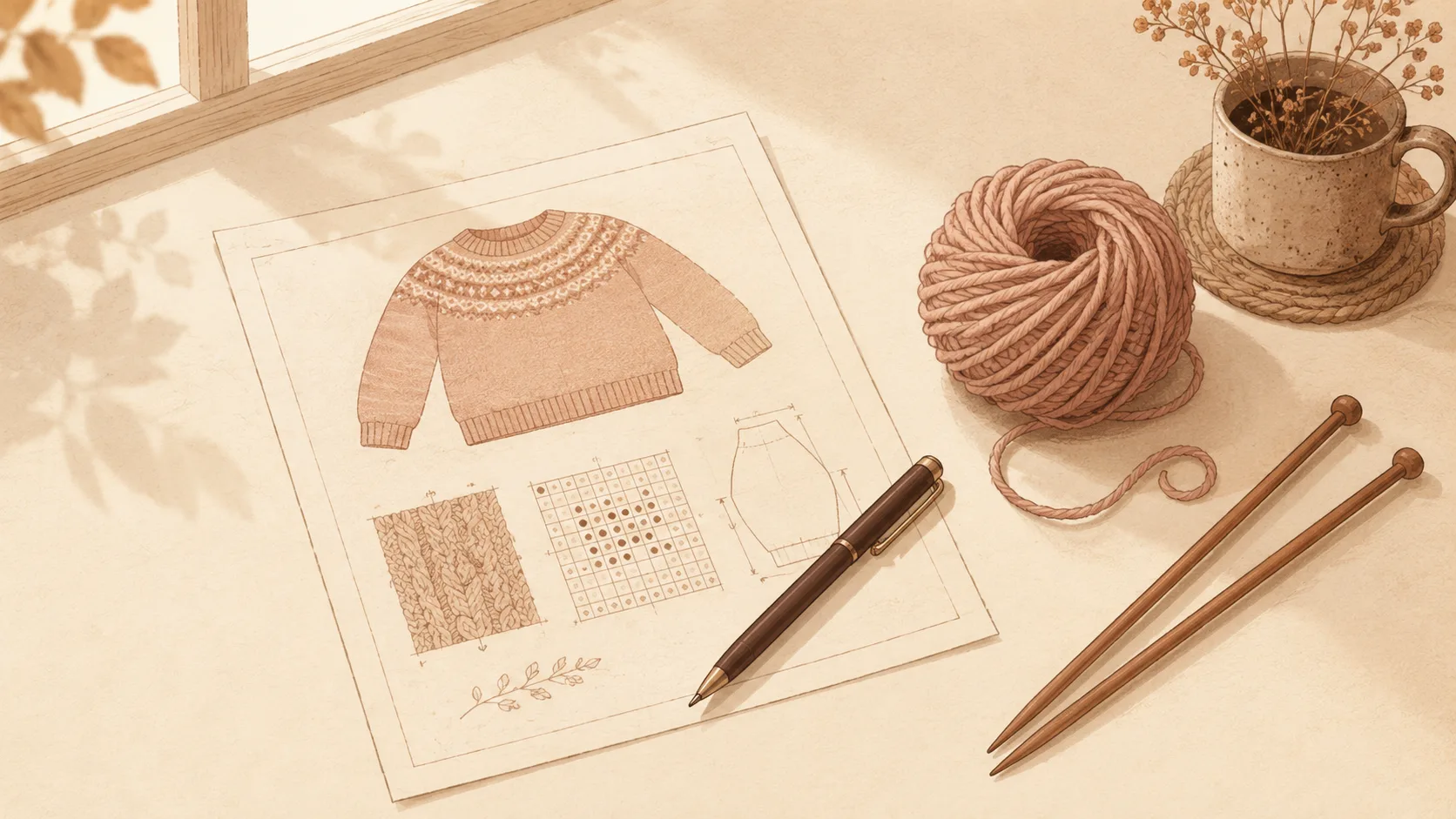
A knitting pattern is shorthand, not a secret code. Once you know that stitches are abbreviated (k, p), that an asterisk marks a repeat, that RS and WS tell you which side you are on, and that a number in parentheses is your stitch count, most patterns open right up. Read the whole thing once, slowly, before you cast on.
Start with the key, not row 1
Most patterns open with the yarn, the needle size, the gauge and a list of abbreviations. Read those first. The abbreviations list is your translation key, and the gauge tells you whether your tension will match so the finished size is right. A quick read-through also shows you the shape of the repeats before your needles are busy.
Knitting abbreviations: your translation key
You do not need to memorise these, just keep the list nearby until they stick.
| Abbr. | Meaning |
|---|---|
| k | knit |
| p | purl |
| st(s) | stitch(es) |
| RS / WS | right side / wrong side |
| yo | yarn over (adds a stitch) |
| k2tog | knit two together (a decrease) |
| inc / dec | increase / decrease |
How repeats work: asterisks, brackets and parentheses
Repeats save space and cause most early confusion. The usual conventions:
- An asterisk marks a starting point: "k2, p2; repeat from to end" means repeat that sequence across the row.
- Brackets or parentheses group stitches to repeat a set number of times: "[k1, yo] 3 times" or "(k2tog) twice".
- Parentheses at the end of a row usually give your stitch count: "(24 sts)".
Designers do not all use these symbols identically, so trust the pattern's own key over any general rule.
RS and WS: which side are you on?
RS is the right side, the front that faces out; WS is the wrong side, the back. Patterns label rows like "Row 1 (RS)" so you always know which side you are working, which matters because many stitches look different from each side. Losing track of RS and WS is a common way a pattern goes wrong, a row counter that you tag by side keeps it straight.
Work through it row by row
Patterns are written one row at a time, usually numbered. Do one full row before moving on, mark each row as you finish it, and check the stitch count at the end of every row. That count is your safety net: a wrong number means the mistake is in the row you just did, not ten rows back.
Keep the pattern and your place together with Knittle
Half of reading a pattern is simply not losing your spot in it. Attach the pattern to your project in Knittle as a PDF, photo or link, track repeats with a cyclic counter like K2P2, and keep your row counter on the same screen. Crocheting too? See how to read a crochet pattern.