

Two things: one hook and one ball of yarn. Every list longer than that is selling you something. If you want the exact pair, buy a smooth light-coloured acrylic in DK or worsted weight, and the hook size printed on its ball band, which will be somewhere between 4 and 5.5 mm.
The honest list
Most beginner guides open with ten items. Here is what each one is actually worth on day one:
| Buy now | Buy once you finish something | Skip for now |
|---|---|---|
| One hook, 4 to 5.5 mm | A few stitch markers | A full hook set |
| One ball of smooth light yarn | A blunt yarn needle for ends | Ergonomic or interchangeable hooks |
| Scissors you already own | A tape measure | Wool, alpaca, mohair, anything fluffy |
Scissors count as free because you have them. That is genuinely the whole starting kit, and the total is the price of one ball of yarn.
Why that hook and that yarn?
The hook size has to match the yarn thickness, which is why the ball band tells you which one to use. Follow the band rather than a number you read somewhere: a hook stamped with the same letter can differ between brands, and only the millimetres are reliable. See crochet hook sizes.
Acrylic for the first ball, not because it is better, but because it is cheap, it does not split, and it survives being pulled out twenty times. You will pull it out twenty times. Save the wool for when that stops happening.
Why the colour matters more than the fibre
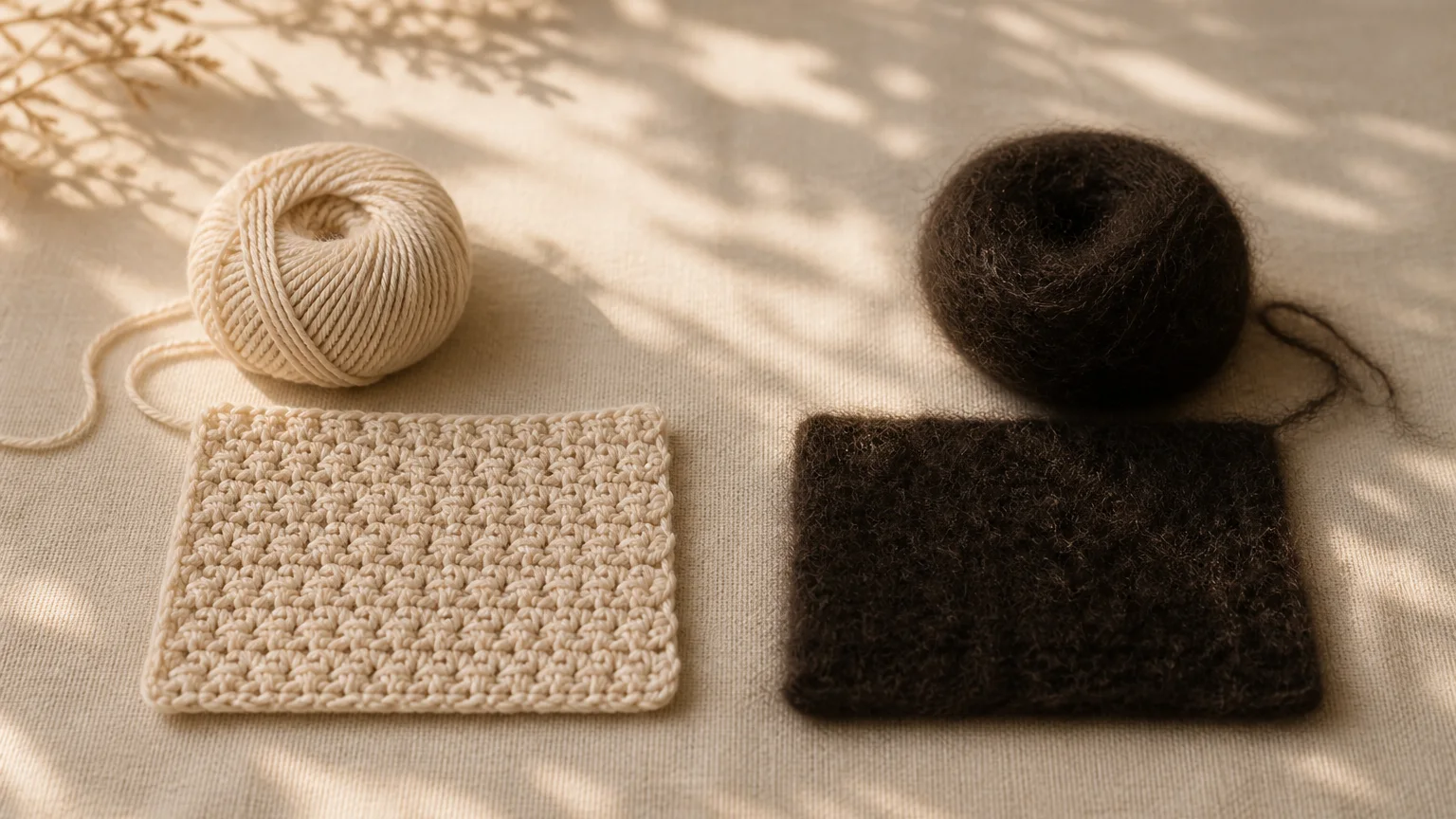
This is the part almost no beginner guide says out loud, and it decides whether your first hour is pleasant or miserable.
You cannot learn to crochet on yarn where you cannot see the stitches. Dark navy, black, variegated, fluffy, anything with a halo: the stitches disappear into the mass. And when you cannot see them, you cannot count them, so every mistake stays invisible until the piece is visibly crooked and it is too late to find where it started.
A pale, smooth, solid colour puts every stitch in plain sight. Cream, oatmeal, dusty pink, light grey. It is the single cheapest thing you can do to make learning easier, and it costs the same as the black one.
What to skip on the first trip
- A hook set. You need one size until you have finished a project. A set is a decision you are not ready to make.
- Ergonomic handles. They solve a pain you do not have yet.
- A pattern. A pattern is a second language on top of a new skill. Learn the chain and one stitch first, then read how to read a crochet pattern.
- Beautiful yarn. It will end up in a practice swatch that you unravel. Buy it for project two.
Your first project
Make a flat square. Not a scarf, which is long and boring, and not a hat, which is worked in the round before you can count a flat row. A washcloth-sized square teaches the three things everything else is built on: making a chain, working rows back and forth, and keeping the same number of stitches on every row.
That last one is where every beginner square goes wrong, and it is worth knowing before you start: see why is my crochet wavy if the edges start to ripple.
Count from the very first row, with Knittle
The habit that separates a straight first square from a wonky one is counting the stitches at the end of every row, from row one. Knittle is a row and stitch counter for crochet and knitting: tap once per row, set a target for your square, and put the work down without losing your place. The count stays with you across your iPhone, iPad and Apple Watch.


