

Read the millimetres, not the letter. The Craft Yarn Council, which sets the US standard, says it plainly: letter and number sizes vary from company to company, so the millimetre marking on the package is the only measurement you can trust. Every chart below is built around that.
Why does the same letter mean two different hooks?
Because the letters were never standardised. The proof is in the Craft Yarn Council's own table, which lists both 3.125 mm and 3.25 mm as D, both 4 mm and 4.25 mm as G, and both 5.25 mm and 5.5 mm as I. If the standards body itself cannot give one letter per size, two brands on the same shelf certainly will not.
So when a pattern says "H hook" and your H gives the wrong gauge, nothing is wrong with you. Find the millimetre size the designer meant, and match that.
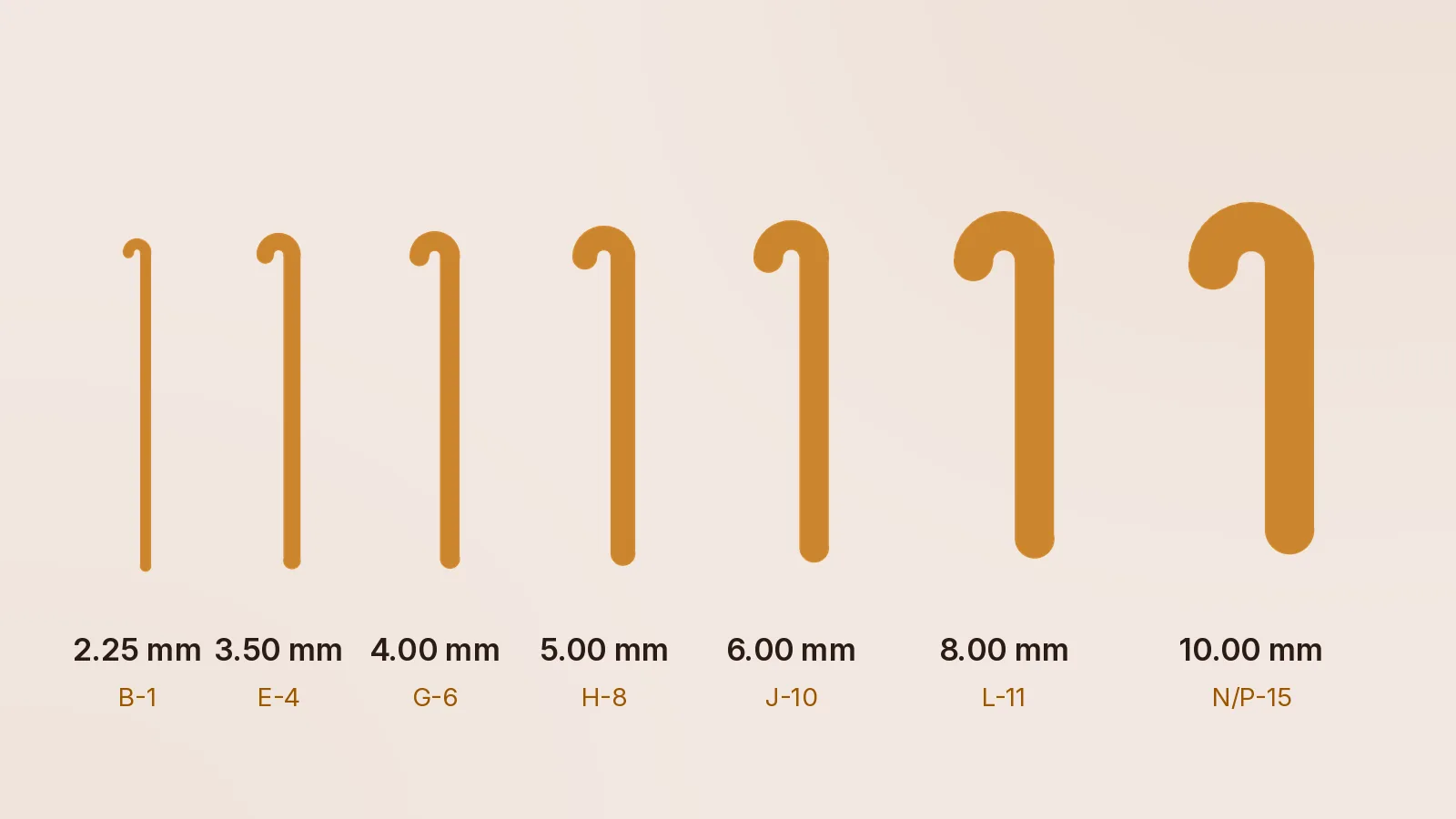
Crochet hook conversion chart
| Metric | US | UK |
|---|---|---|
| 2.25 mm | B-1 | 13 |
| 2.75 mm | C-2 | 11 |
| 3.25 mm | D-3 | 10 |
| 3.50 mm | E-4 | 9 |
| 3.75 mm | F-5 | - |
| 4.00 mm | G-6 | 8 |
| 4.50 mm | 7 | 7 |
| 5.00 mm | H-8 | 6 |
| 5.50 mm | I-9 | 5 |
| 6.00 mm | J-10 | 4 |
| 6.50 mm | K-10 1/2 | 3 |
| 8.00 mm | L-11 | 0 |
Above 8 mm the UK numbers run out and only the US letters continue: 9 mm is M or N-13, 10 mm is N or P-15, 15 mm is Q, 19 mm is S. Note that even here the letters double up, which is the same problem again.
Which hook for which yarn?
These are the Craft Yarn Council's recommended ranges by yarn weight:
| Yarn weight | Hook range |
|---|---|
| 0 Lace | 1.4 to 2.25 mm |
| 1 Super fine | 2.25 to 3.50 mm |
| 2 Fine | 3.50 to 4.50 mm |
| 3 Light | 4.50 to 5.50 mm |
| 4 Medium | 5.50 to 6.50 mm |
| 5 Bulky | 6.50 to 9.00 mm |
| 6 Super bulky | 9.00 to 15.00 mm |
| 7 Jumbo | 15.00 mm and up |
The Council prints one word above this table that almost every copy of it drops: guidelines. They are the sizes most people reach for, not a rule. Your gauge swatch decides, and if your fabric is stiff or floppy you change hook regardless of what any chart says. See why is my gauge wrong.
Why do UK sizes run backwards?
In the UK system the number goes down as the hook gets bigger: 13 is a 2.25 mm, 3 is a 6.50 mm. It is a survivor of an old wire gauge, where the number counted drawing steps rather than thickness. Nothing about it is intuitive, and it is the reason a UK pattern can feel like it is describing a different craft. If you also hit UK stitch names, see US vs UK crochet terms.
Steel hooks are a third system, also inverted
Thread crochet uses steel hooks with their own numbering, and it runs backwards too: the higher the number, the smaller the hook. A steel 6 is about 1.60 mm, a steel 12 is about 1.00 mm. They live in a range no regular hook reaches, roughly 0.60 to 3.50 mm, and they pair with thread sizes 3, 5, 10, 20 and 30.
The practical consequence: a "size 7" hook can mean a 4.50 mm aluminium hook or a 1.65 mm steel one. Only the millimetres tell you which.
Keep the hook with the project in Knittle
The hook you used is part of the project, not a detail you will remember in three weeks. Knittle is a row and stitch counter for crochet and knitting: keep a note of the hook and yarn beside the count for each project, set a target, and pick the work back up without guessing. Your projects stay with you across your iPhone, iPad and Apple Watch.


