

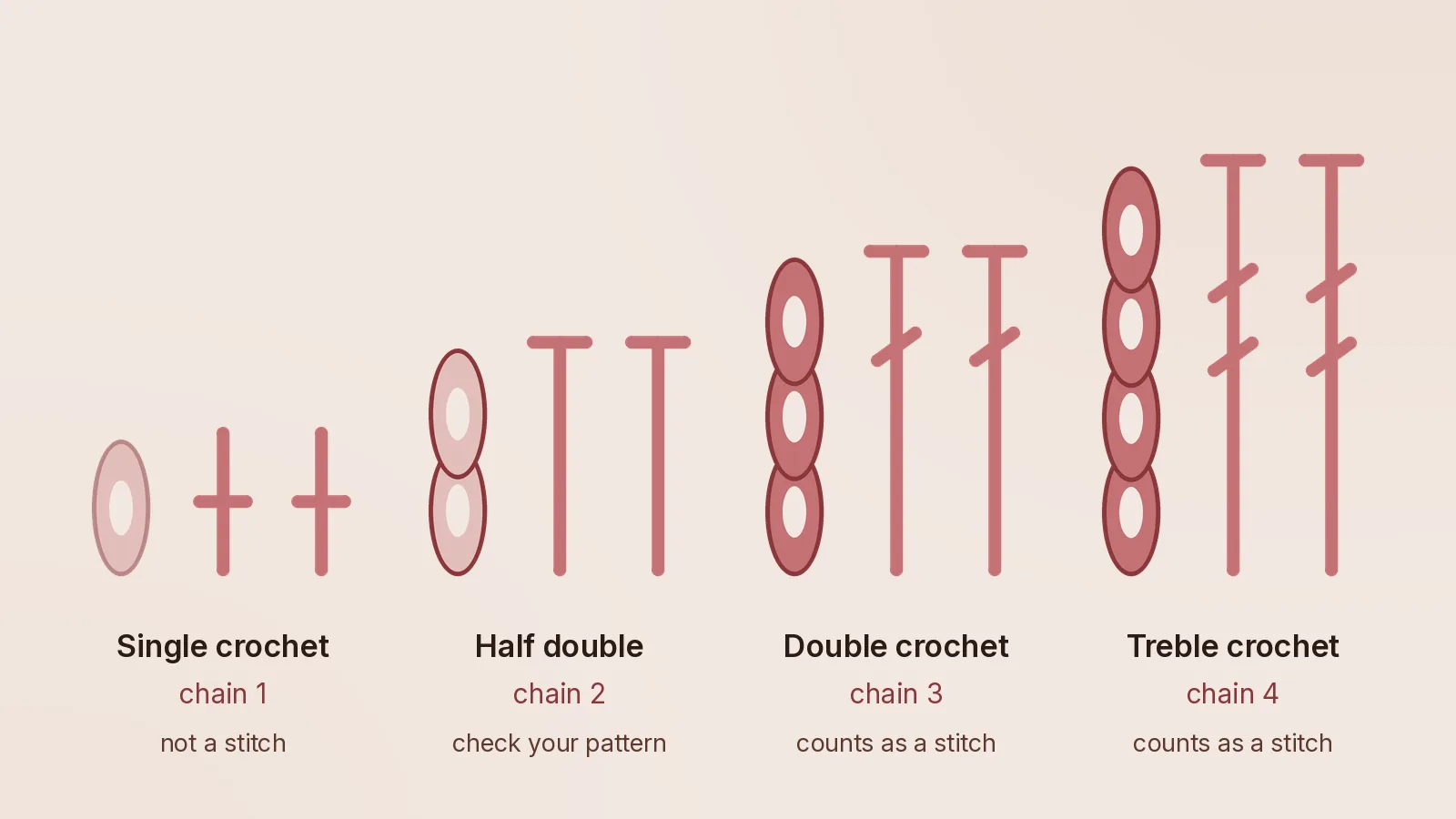
Short answer: with single crochet the turning chain does not count as a stitch, and with double crochet or taller it usually does. Half double crochet goes either way. Getting this wrong is the most common reason a flat piece slowly grows wider or narrower, so here is the full chart.
What the turning chain is actually for
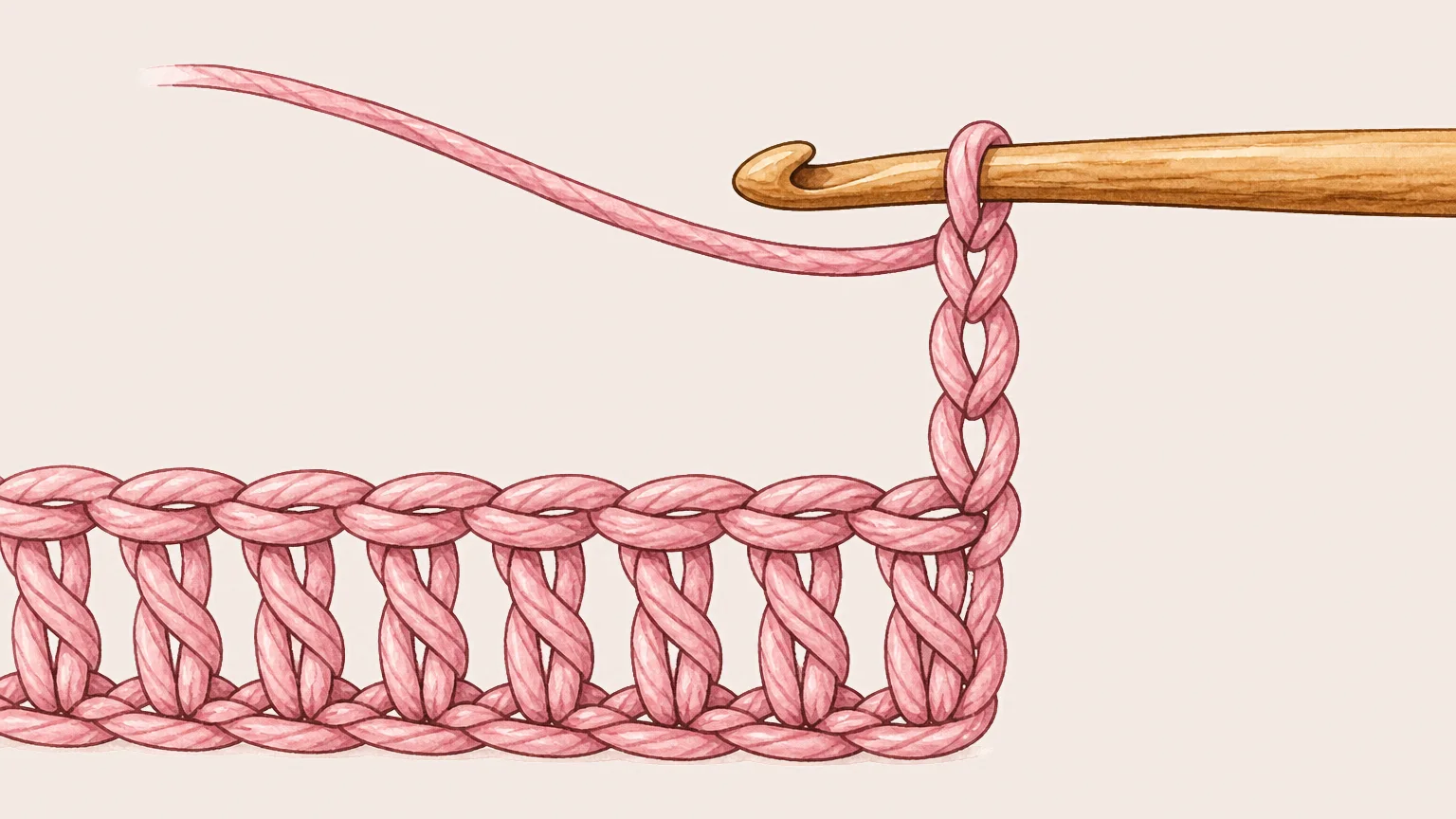
A row of double crochet is taller than a row of single crochet. The turning chain lifts your hook up to the height of the row you are about to work, so the first stitch does not drag the edge down. That is its whole job. Whether it also stands in for the first stitch is a separate question, and that is the one that trips people up.
Does the turning chain count as a stitch?
Here is the standard convention in US terms. Your pattern always wins if it says otherwise.
| Stitch | Turning chain | Counts as a stitch? | First stitch of the row | Last stitch of the row |
|---|---|---|---|---|
| Single crochet (sc) | ch 1 | No | Into the first stitch | Into the last stitch |
| Half double crochet (hdc) | ch 2 | Either way, check the pattern | If it counts, skip the first stitch | If it counts, into the top of the turning chain |
| Double crochet (dc) | ch 3 | Usually yes | Skip the first stitch | Into the top of the turning chain |
| Treble crochet (tr) | ch 4 | Usually yes | Skip the first stitch | Into the top of the turning chain |
Many modern designers now use ch 2 for double crochet and do not count it, because a ch 3 leaves a visible gap at the edge. If your pattern says "ch 2, dc in first st", that is what is happening, and it is not a mistake.
If your pattern is written in UK terms, every stitch height shifts by one name, so check US vs UK crochet terms before you use the chart.
What if the pattern does not say?
Plenty of patterns never spell it out. Two clues, then a decision.
- Read the row instruction closely. "Ch 3, dc in next st" means the chain counts, because the row starts in the next stitch along. "Ch 3, dc in first st" means it does not.
- Check the stitch count at the end of row 1. If the pattern promises 20 dc and you only reach 20 by including the chain, it counts.
If neither settles it, pick one, write it at the top of your pattern, and do the same thing on every single row. Consistency matters more than which option you picked, because the edge stays straight either way.
How do I tell which mistake I made?
Count your stitches at the end of a row and compare with the pattern. The direction of the error tells you exactly what went wrong.
| What you see | What went wrong |
|---|---|
| One extra stitch, every row | Either you worked into the first stitch when the chain counts, or you worked into the turning chain when it does not |
| One missing stitch, every row | Either you skipped the first stitch when the chain does not count, or you missed the top of the turning chain when it does |
| The count drifts, up on some rows and down on others | You are treating the chain differently from row to row |
This is why wavy or crooked crochet so often comes back to the turning chain, and why counting at the end of every row catches it in seconds instead of ten rows later. Putting a marker in the first stitch of each row makes that edge easy to find: see how to use stitch markers in crochet.
Keep the count with Knittle
The turning chain only costs you a project when the error goes unnoticed for twenty rows. Knittle is a row and stitch counter for crochet and knitting: tap once per row, set a target to watch the progress ring fill, and put your work down without losing your place. Your counts stay with you across your iPhone, iPad and Apple Watch, so you can check the edge before it drifts.


